Students from Antioch University Seattle’s Decoloniality & Social Privilege Awareness Initiative presented a variety of projects at the 2026 American Psychological Association Conference in Washington, D.C. Take a look at all the amazing projects presented:

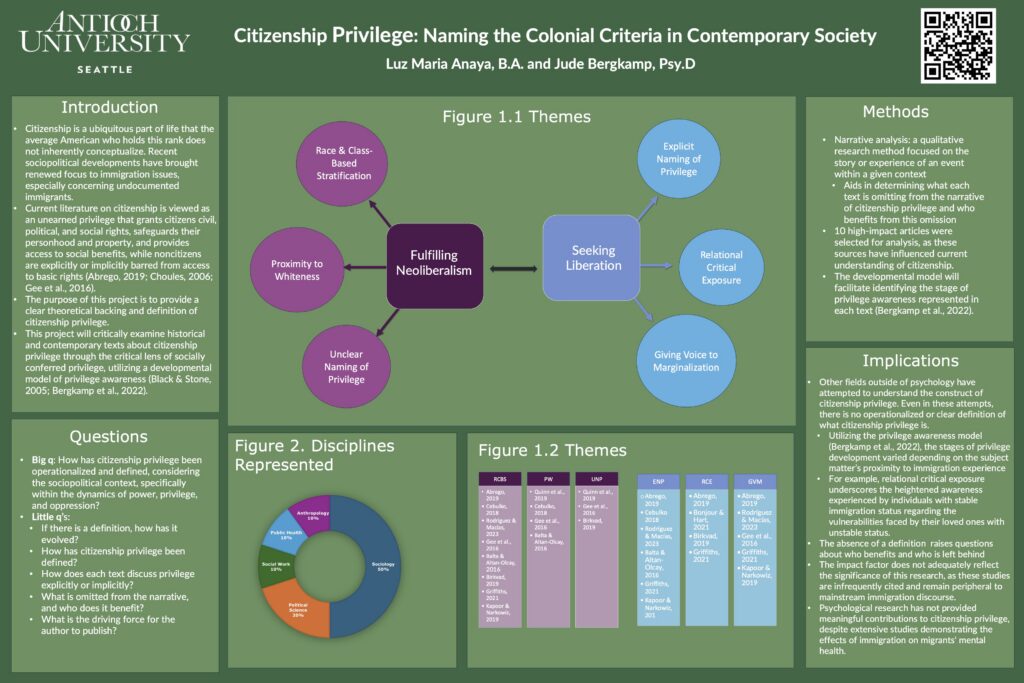
Citizenship Privilege: Naming the Colonial Criteria in Contemporary Society
By: Luz Maria Anaya
Citizenship is a ubiquitous part of life that the average American who holds this rank does not inherently conceptualize. Recent sociopolitical developments have brought renewed focus to immigration issues, especially concerning undocumented immigrants. From the literature, it is clear that those who do not hold citizenship rank are more likely to experience psychological distress and increased difficulty with upward mobility regarding socioeconomic status (Galvez, 2013; Gee et al., 2016). Current literature on citizenship is viewed as an unearned privilege that grants citizens civil, political, and social rights, safeguards their personhood and property, and provides access to social benefits, while noncitizens are explicitly or implicitly barred from access to basic rights (Abrego, 2019; Choules, 2006; Gee et al., 2016). However, there is little written on what citizenship privilege is beyond research in sociology and law, with a clear gap in contributions from clinical psychology. Likewise, there is little research on the role those with this privilege hold. The purpose of this project is to provide a clear theoretical backing and definition of citizenship privilege. Current research will be examined through the critical lens of socially conferred privilege, utilizing a developmental model of privilege awareness (Black & Stone, 2005; Bergkamp et al., 2022). Specifically, the researcher will employ narrative analysis to examine 10 articles based on their impact factor and face validity, thereby identifying overarching themes that inform theory and definition (Josselson & Hammock, 2021). The issue of immigration has been a primary focus of the current administration, and the enforcement tactics have implications for the psychological well-being of not only immigrants but the population at large. This is the first step in a larger project of citizenship privilege that will help provide a definition and theory that can inform future research.
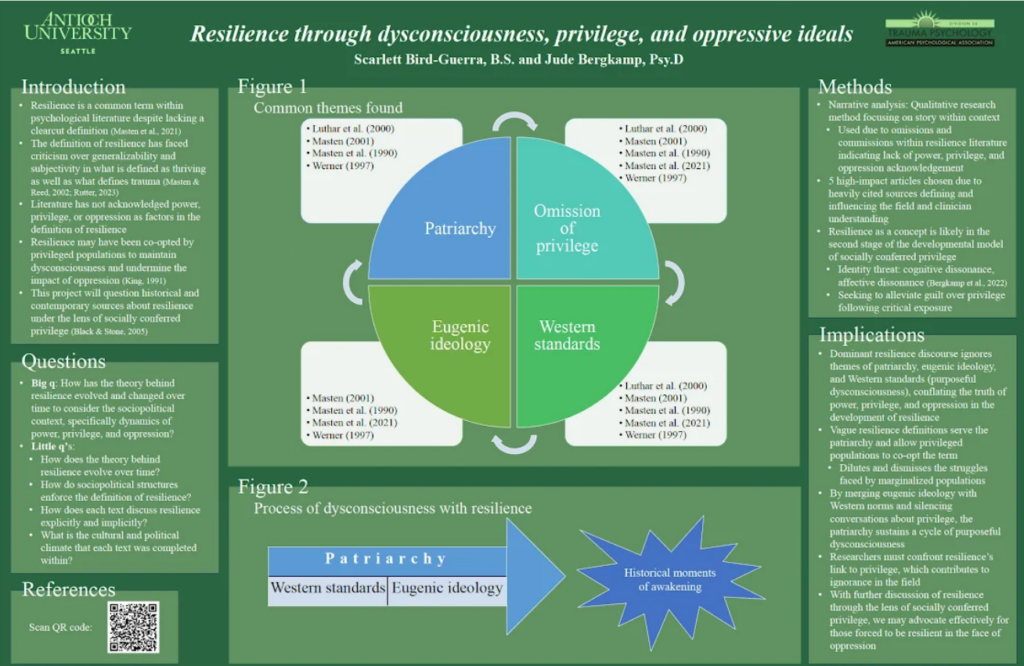
Resilience Through Dysconsciousness, Privilege, and Oppressive Ideals
By: Scarlett Bird-Guerra
Resilience is an extremely common term within psychological literature despite lacking a clearcut definition (Masten et al., 2021). Originally conceptualized by Freud around the 1920s, the definition remains fairly consistent over time with the idea that resilience is an individual trait (Bálint, 1942; Masten et al., 2021). From a preliminary review of the literature, resilience has faced criticism regarding its generalizability and subjectivity in what is defined as flourishing or thriving as well as what defines trauma (Masten & Reed, 2002; Rutter, 2023). For example, the definition fluctuates between utilization of the neurobiological, developmental, and psychosocial lens (Feldman, 2020; Herrman et al., 2011; Wu et al., 2013). Yet, literature has not acknowledged power, privilege, or oppression as factors in the definition of resilience. Thus, resilience may have been co-opted by privileged populations to maintain dysconsciousness and undermine the impact of oppression (King, 1991). This project will interrogate historical and contemporary sources regarding resilience through the lens of socially conferred privilege (Black & Stone, 2005). When considering the developmental model of socially conferred privilege, the concept of resilience would likely be in the third stage of identity protection due to empty advocacy and dilution of underprivileged communities’ experiences (Bergkamp et al., 2022). Using narrative analysis, five sources will be chosen according to impact factor connoting heavy utilization in research and high dissemination in the field. Implications could result in a more sophisticated theory and definition of resilience that matches the contemporary reality of oppression. Consequently, the resulting concept of resilience could influence how clinicians treat marginalized populations through consideration of the historical ways in which resilience has been used as an oppressive factor. Implications include influence of assessment, diagnosis, interventions, and further research.
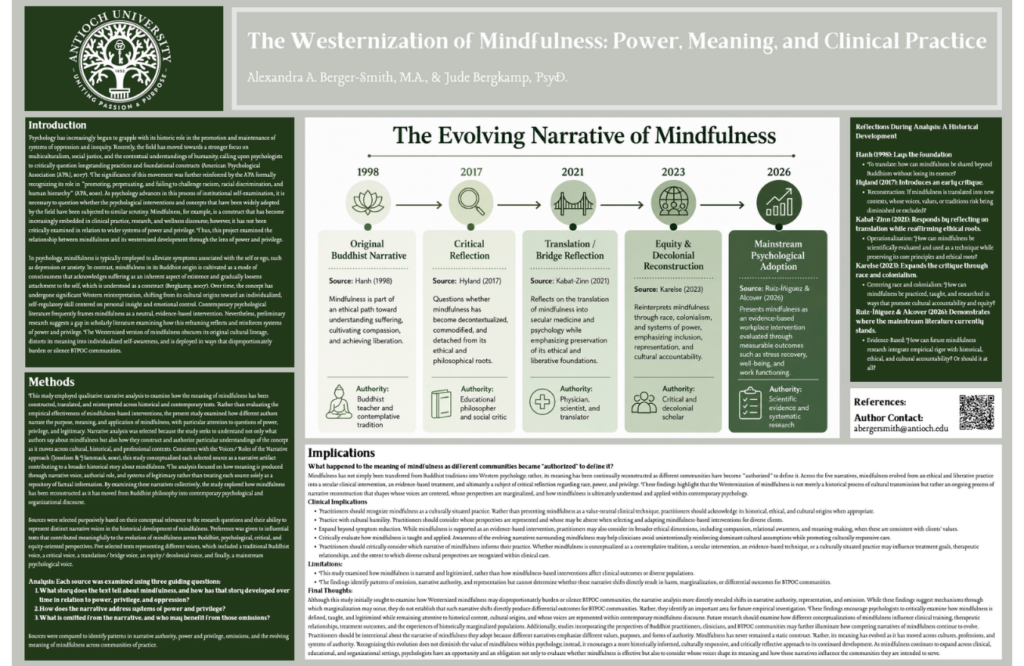
The Westernization of Mindfulness: Power, Meaning, and Clinical Practice
By: Alexandra Berger-Smith
In psychology, mindfulness is typically employed to alleviate symptoms associated with the self or ego, such as depression or anxiety. In contrast, mindfulness in its Buddhist origin is cultivated as a mode of consciousness that acknowledges suffering as an inherent aspect of existence and gradually loosens attachment to the self, which is understood as a construct (Bergkamp, 2007). Over time, the concept has undergone significant Western reinterpretation, shifting from its cultural origins toward an individualized, self-regulatory skill centered on personal insight and emotional control. Contemporary psychological literature frequently frames mindfulness as a neutral, evidence-based intervention. Nevertheless, preliminary research suggests a gap in scholarly literature examining how this reframing reflects and reinforces systems of power and privilege. The Westernized version of mindfulness obscures its original cultural lineage, distorts its meaning into individualized self-awareness, and is deployed in ways that disproportionately burden or silence BIPOC communities. This project will interrogate five historical and contemporary sources using narrative analysis to examine how meanings of mindfulness are constructed, edited, and legitimized through the lens of socially conferred privilege, including a developmental model of privilege awareness (Black & Stone, 2005; Bergkamp et al., 2022). Sources will be selected based on relevance and contemporary impact factor within clinical and academic discourse. The analysis will attend to how narratives embedded in these texts elevate Western interpretations of mindfulness while marginalizing or erasing others. Implications will include a more critical and culturally grounded understanding of mindfulness, offering clinicians and scholars a broader framework for working with marginalized populations and reducing the potential for the construct’s weaponization in therapeutic, educational, and organizational settings.
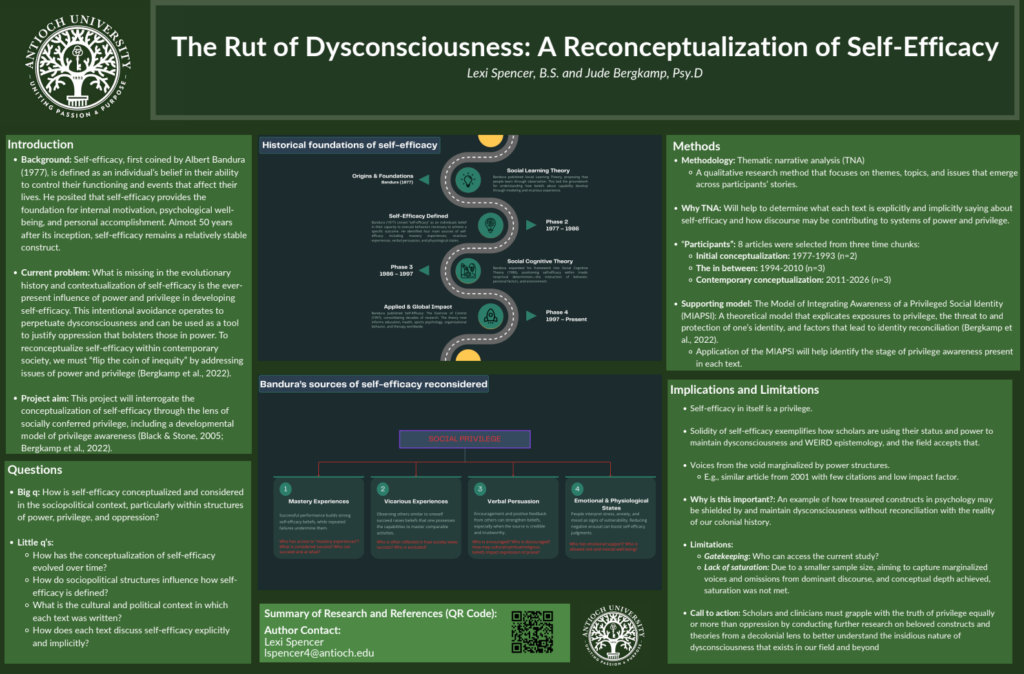
The Rut of Dysconsciousness: A Reconceptualization of Self-Efficacy
By: Lexi Spencer
Self-efficacy, first coined by Albert Bandura (1977), is defined as an individual’s belief in their ability to control their functioning and events that affect their lives. He posited that self-efficacy underpins internal motivation, psychological well-being, and personal accomplishment. Almost 50 years after its inception, self-efficacy remains a relatively stable construct, and research is often confined to topics surrounding educational attainment and substance abuse (Zimmerman et al., 1992; Kadden & Litt, 2011). Transformations in understanding self-efficacy have centered on whether it is conceptualized as specific or general, as a matter of capability or motivation, as malleable or stable, and on contextual influences that shape the construct (Weir, 2025; Burke et al., 2009). What is missing from the evolutionary history and contextualization of self-efficacy is the ever-present influence of power and privilege in its development, as evidenced by children from wealthier families attending more prestigious universities and by the pay gap between men and all other genders. This intentional avoidance operates to perpetuate dysconsciousness and can be used as a tool to justify oppression that bolsters those in power. To reconceptualize self-efficacy in contemporary society, we must “flip the coin of inequity” by addressing issues of power and privilege (Bergkamp et al., 2022). Thus, this project will interrogate the conceptualization of self-efficacy through the lens of socially-conferred privilege, including a developmental model of privilege awareness (Black & Stone, 2005; Bergkamp et al., 2022). Specifically, the researcher will use narrative analysis to examine 10 articles based on impact factor and face validity, thereby identifying overarching themes that inform theory and definition (Josselson & Hammock, 2021). By addressing the privilege associated with high self-efficacy, we can develop a nuanced understanding of motivation, well-being, and personal accomplishment as advantages afforded to individuals from certain groups (i.e., WEIRD populations).
Re-Defining Authenticity: Self-Expression, Safety, and Social Privilege
By: Amanda Henkel
Western conceptualizations of authenticity have intensified in social significance, from ancient Greek philosophy to 16th-18th-century European existentialism and beyond. The desire to be “true to oneself” has become deeply embedded in postmodern Western culture and contemporary psychology. Current perspectives in psychotherapeutic practice remain grounded in 20th-century humanistic theory, characterized by Rogerian emphasis on congruence between internal states and external expression, and “the matching of one’s inner thoughts, beliefs, and feelings with one’s outer presentation and behaviors” (Burks & Robbins, 2012). While popular models frame authenticity as a hallmark of psychological well-being, social success, and productivity, normative definitions of authenticity overlook contextual constraints that shape whether an individual’s self-expression is safe or adaptive, especially for those from marginalized populations. As a result, adaptive strategies such as strategic concealment, code-switching, and context-dependent self-expression may be implicitly framed as indicators of inauthenticity or psychological deficit rather than responses to a lack of environmental safety. In our approach to theories of authenticity, we contend that a lack of groundedness in sociopolitical context produces systematic threats to construct validity, conflating psychological functioning with possession of social privilege and obscuring lived experiences of marginalized individuals navigating between authenticity and survival.This project will examine historical and contemporary literature on authenticity through a critical lens of socially conferred privilege, using a developmental model of privilege awareness (Black & Stone, 2005; Bergkamp et al., 2022). Researchers will analyze a sample of 10 contemporary articles, chosen by impact factor, to identify themes shaping influential orientations toward authenticity and explore the conceptual limits of prevailing context-independent frameworks. By interrogating normative definitions of authenticity, this project aims to advance equitable conceptualizations of authenticity in psychological science via corrective considerations of safety, power, and privilege.
